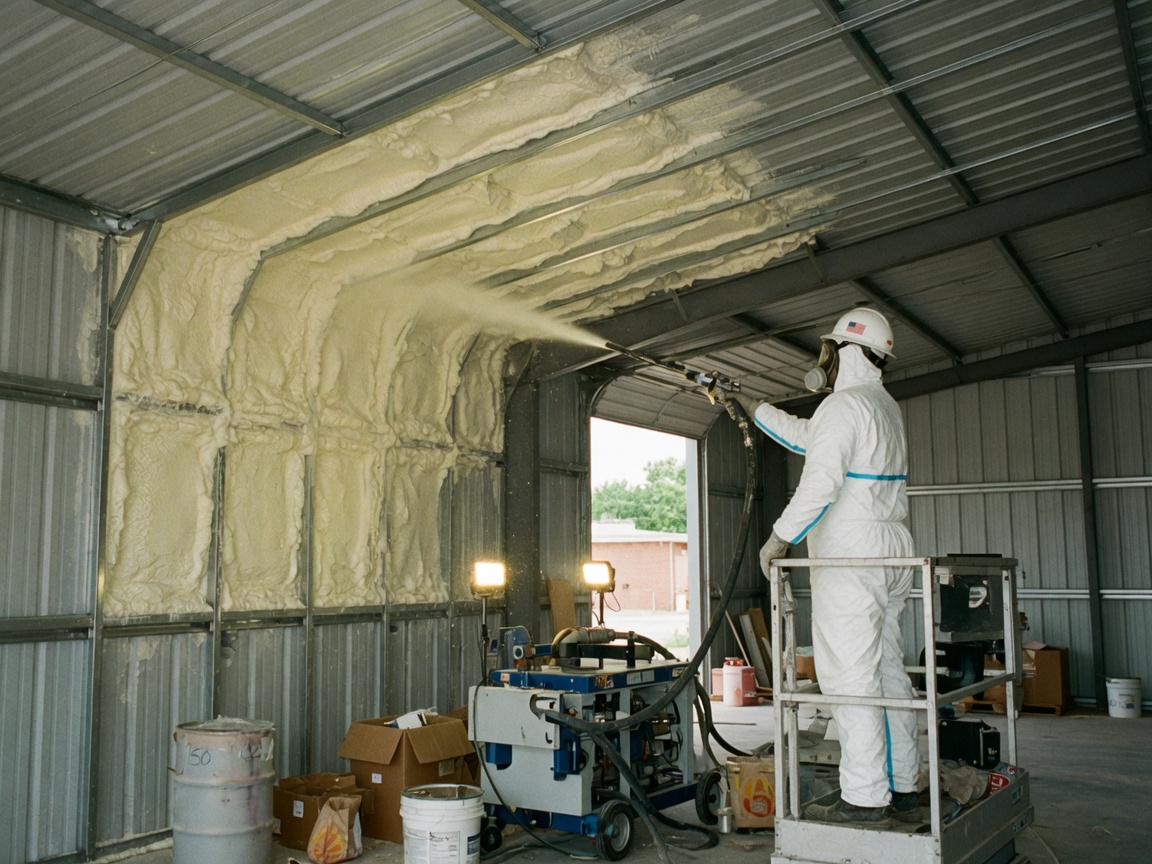
Metal buildings in Jenks and South Jenks often face rapid heat buildup during humid subtropical summers, making closed-cell spray foam the practical choice for roof decks and walls because it adheres directly to steel and creates an air and moisture barrier without additional vapor retarders. In Tulsa County structures near the Jenks Riverwalk or Central Park, mild winters still produce enough temperature swings that open-cell foam alone can allow condensation on interior liners unless a hybrid system is used. Edge cases include older metal buildings with corrugated panels where gaps and fasteners must be addressed before spraying to prevent trapped moisture that leads to rust.
Application crews working Downtown Jenks or Riverwalk commercial properties routinely check for existing rust scale and oil residue on metal surfaces, since these prevent proper adhesion and require power washing or primer steps that add time. Foam thickness is adjusted on site for roof slopes common in the area to ensure drainage is not blocked, and expansion is monitored closely in confined wall cavities to avoid bowing panels. Code considerations in Tulsa County focus on fire ratings for exposed foam in occupied metal buildings, so ignition barriers are installed where required rather than relying on generic claims.
Seasonal timing matters because high summer humidity slows curing and can affect cell structure if temperatures exceed typical ranges, while spring and fall jobs in Jenks allow faster turnaround. Soil conditions near the Arkansas River corridor can contribute to higher ground moisture that travels up metal walls, so floor-to-wall transitions receive extra attention with closed-cell foam to block vapor drive.
Technician insight
In Jenks, the thing that catches most people out with Metal Building Spray Foam Insulation is underestimating how river humidity travels up metal walls from the ground; without closed-cell foam at the base and proper perimeter sealing, condensation reappears within a season even after roof work is done.
South Jenks Warehouse Roof
A metal warehouse near South Jenks showed persistent drip from the roof deck during mild winter mornings. Inspection found gaps at panel laps allowing humid air to reach the steel. Closed-cell spray foam was applied across the underside after surface prep, sealing all joints and adding an R-30 layer. Condensation stopped and interior temperatures stabilized without added HVAC load.
Metal Building Spray Foam Insulation Services We Offer
✓Metal Building Roof Insulation
Closed-cell spray foam applied directly to steel roof decks reduces heat gain and stops condensation in Jenks commercial and agricultural metal buildings.
✓Wall Cavity Spray Foam
Open or closed cell foam fills between girts and purlins to improve thermal performance without adding bulk to interior liners.
✓Condensation Control Treatment
Targeted closed-cell applications on metal surfaces in humid Tulsa County buildings prevent drip and corrosion common during mild winters.
✓Metal Building Attic Insulation
Spray foam seals the underside of roof panels and ridge vents in structures near South Jenks or Broken Arrow to limit air leakage.
✓Floor Insulation for Metal Buildings
Closed-cell foam under slab edges and perimeter walls blocks ground moisture migration in Jenks metal shops and warehouses.
Metal Building Spray Foam Insulation Cost in Jenks, OK
| Service | Typical Range | What Affects It |
|---|---|---|
| Roof Deck Insulation | $1.80–$3.20 per sq ft | Thickness and roof access in multi-story Jenks buildings move the price |
| Wall Insulation | $1.50–$2.75 per sq ft | Open vs closed cell and existing liner condition |
| Full Building Package | $2.10–$3.50 per sq ft | Includes roof, walls, and perimeter floor transition |
| Condensation Treatment Only | $1.20–$2.00 per sq ft | Targeted areas on existing metal structures |
Ranges are typical for Jenks, OK and confirmed with an exact written quote before any work starts.
How it works
- 1
Site Assessment
Inspect metal panels, fasteners, and existing rust in the specific Jenks building while noting roof pitch and access points.
- 2
Surface Preparation
Power wash or prime steel surfaces to remove oils and scale so foam bonds properly in the local humidity.
- 3
Foam Application
Spray closed or open cell foam to specified thickness on roofs, walls, or floors while monitoring expansion.
- 4
Finishing and Inspection
Install ignition barriers where required and verify coverage before final walkthrough.
Pricing
Typical metal building projects are quoted by square footage after on-site measurement; ranges reflect foam type and access difficulty.